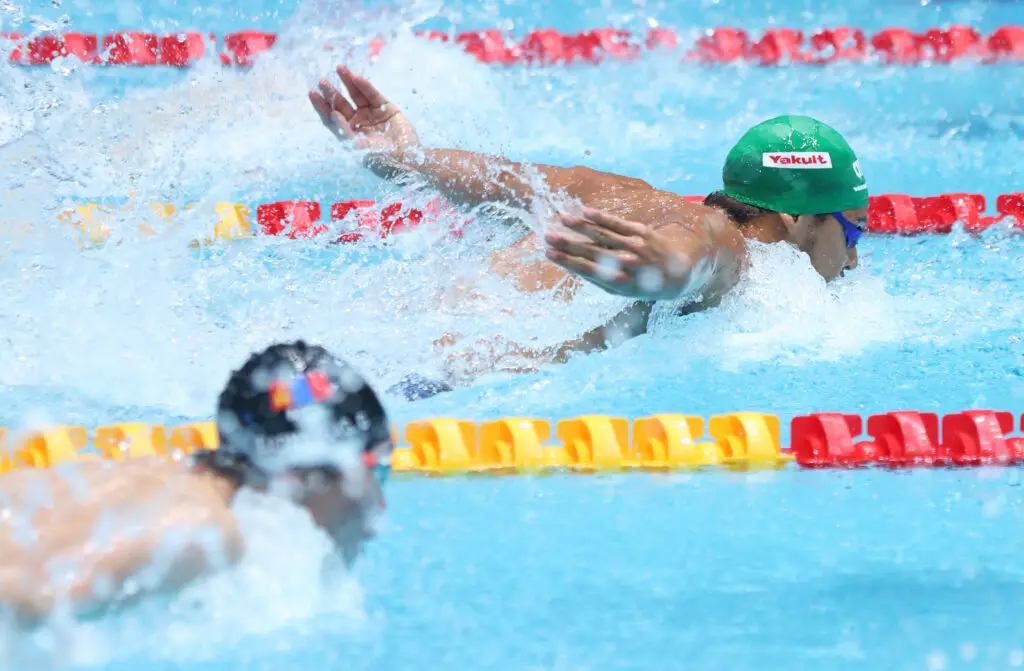
Michael Houlie operates in extremes. Behind the blocks, the South African breaststroke specialist is known for a loose, playful energy that makes him a magnet for photographers and fans. But the moment the starter’s buzzer sounds, that relaxed demeanour vanishes into 25 seconds of raw, explosive power. This duality was on full display during the 2026 World Aquatics Swimming World Cup in Tashkent, where an untapered Houlie clocked a blistering 25.67 to capture 50m breaststroke gold against a stacked international field.
It is a milestone that marks the peak of an incredibly unorthodox journey for an athlete who, by his own admission, was never supposed to be a swimmer.
During his youth at Diocesan College in Cape Town, Houlie was a dedicated water polo player whose relentless energy was perfectly suited for the physical, multi-directional demands of the game. “It was like football in water,” Houlie recalls. “It suited my personality because I could move all the time, even when I was on the bench! It was the perfect outlet for my high energy.”
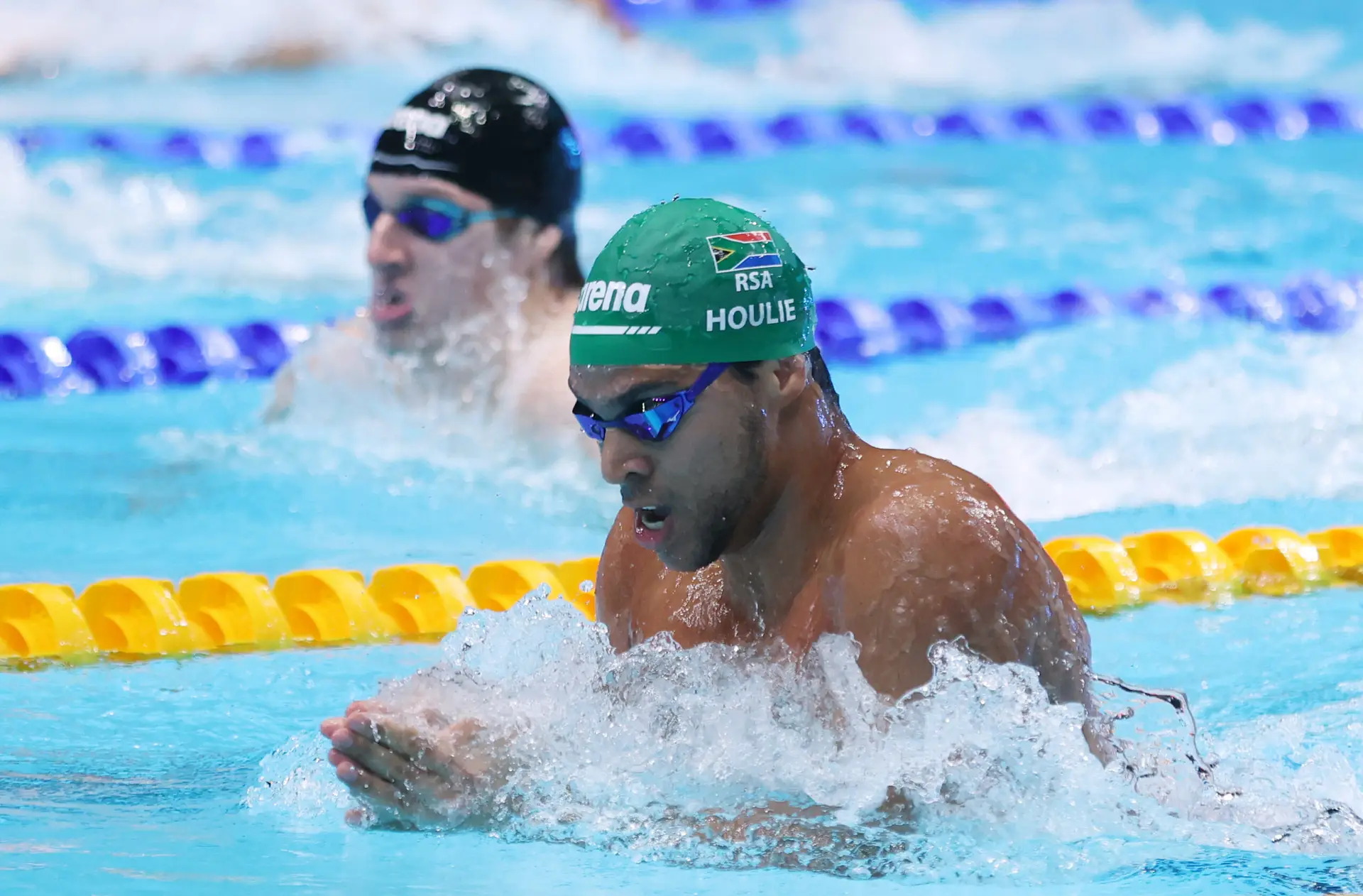
ASTANA, KAZAKHSTAN - OCTOBER 16: Michael Houlie of South Africa competes in the Men's 100m Individual Medley Heats on day two of the World Aquatics Swimming World Cup at Barys Arena on October 16, 2026 in Astana, Kazakhstan. (Photo by Victor Magdeyev/Getty Images)
His entry into competitive swimming was born out of sheer pragmatism. At the time, he was only attending one pure swimming session a week, much to his coach’s frustration. Faced with an ultimatum to either compete at the 2015 Level 3 Championships or be kicked out of the squad, Houlie agreed simply to stay with his friends. He stepped onto the blocks and broke the national age-group record in his very first 50m breaststroke race.
“I always say swimming found me,” Houlie says. “I was a reluctant swimmer, but that one race forced me to take notice.”
The realization of his true potential hit a few months later at the African Junior Championships. Still training for swimming just twice a week, he swept the breaststroke events, including a 200m race he famously swam at an all-out sprint from the buzzer. “They practically had to carry me out of the pool afterwards,” he laughs, noting everyone thought he was a “kamikaze swimmer.” By the end of 2015, he hung up his water polo cap for good, trading it for the black line at the bottom of the pool. He credits that late transition for his unique spatial awareness and mechanical versatility in the water today.
Houlie eventually moved to the United States to compete for the University of Tennessee in 2019. The rigorous NCAA system instilled the racing discipline, nutritional habits, and technical foundations required to turn his raw talent into a world-class stroke. Yet, the true test of his resolve arrived much later, in 2025, when an emergency appendectomy derailed his season, forcing him out of the water for 10 gruelling weeks.
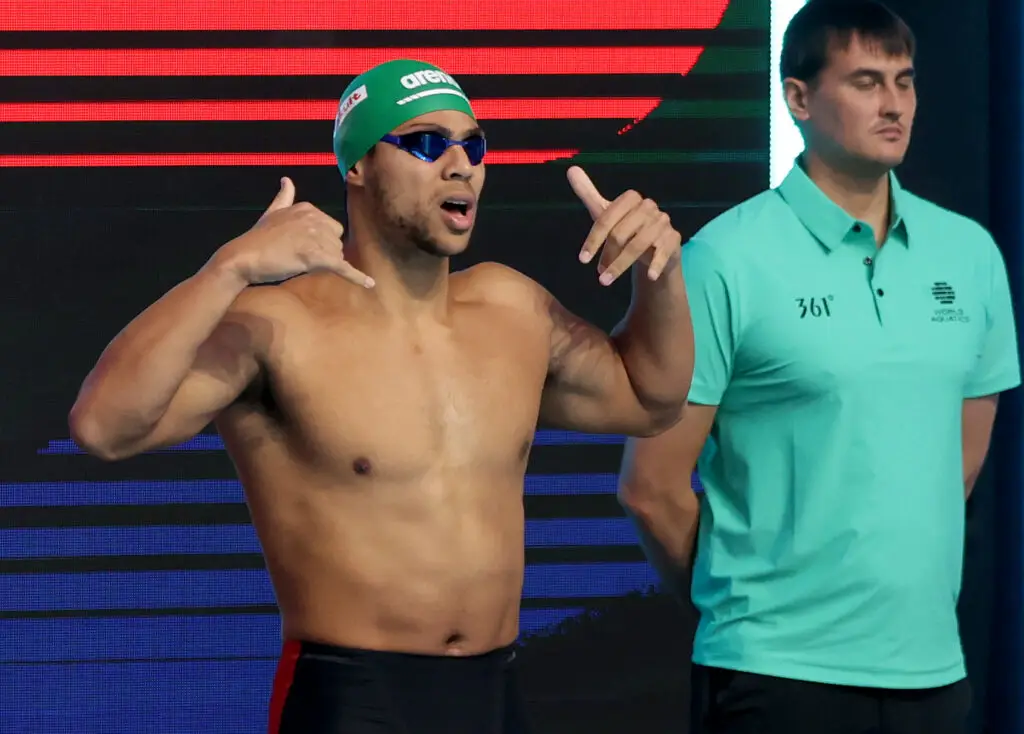
ASTANA, KAZAKHSTAN - OCTOBER 15: Michael Houlie of South Africa reacts prior to competing in the Men's 50m Breaststroke Final on day one of the World Aquatics Swimming World Cup at Barys Arena on October 15, 2026 in Astana, Kazakhstan. (Photo by Victor Magdeyev/Getty Images)
Stripped of his physical momentum, Houlie leaned entirely on visualization and patience. The extended absence proved to be a pivotal mental reset. “During recovery, there was a lot of uncertainty because I felt like I was going backwards,” he admits. “But the best part of the whole experience was something I hadn’t expected. I discovered just how much I missed swimming and how much I genuinely loved the process.”
That love for the process is what fuels his current grind on the global circuit. Since late 2023, Houlie has taken full ownership of his career by coaching himself, funding his international ambitions through side jobs ranging from lifeguarding to university library shifts. Rather than viewing his lack of a fully funded, structured program as a disadvantage, he embraces the accountability it demands.
“If you think you’re at a disadvantage, then you’ve already lost,” Houlie says with absolute conviction. “We’re South Africans. We believe we can win and beat anyone. It’s a mindset. Everyone standing on those starting blocks has a backstory. When the race starts, nobody cares how you got there.”
That fierce mentality paid historic dividends throughout the 2026 season. Beyond his individual World Cup gold in Tashkent and Pan Pacs silver in California, Houlie was instrumental in anchoring Team SA to two African Records in the medley relays at the Commonwealth Games in Glasgow. The relay environment, forged in the intense fires of SEC collegiate swimming, brought out an entirely different gear. Racing alongside veteran Chad le Clos, the squad shared a unity that transcended individual accolades. “We were all swimming for Chad le Clos,” Houlie says. “We understood what the occasion meant, and we wanted to give absolutely everything for him and for Team South Africa. We were willing to die for him!”
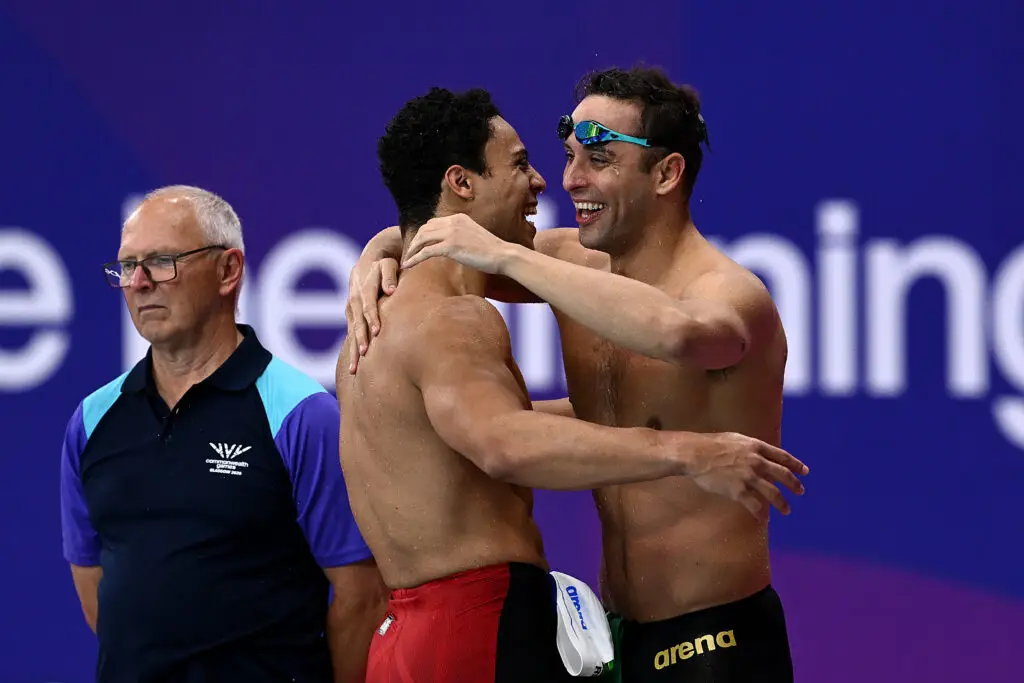
GLASGOW, SCOTLAND - JULY 29: Michael Houlie and Chad le Clos of Team South Africa celebrate after winning the bronze medal during the Men's 4 x 100m Medley Relay Final on day six of the Glasgow 2026 Commonwealth Games at Tollcross International Swimming Centre on July 29, 2026 in Glasgow, Scotland. (Photo by Quinn Rooney/Getty Images)
Houlie now finds himself stepping into a leadership role, carrying the breaststroke torch passed down by South African icons like Cameron van der Burgh. With the 50m breaststroke officially added to the Olympic program for LA2028, he is fully embracing what he calls the “Sprint Revolution,” pushing the boundaries of traditional athletic longevity alongside peers like Australia’s Cam McEvoy and compatriot Tatjana Smith.
As he prepares for the World Short Course Championships in Beijing this December, his focus remains strictly on the daily work, a process he refers to as #THP. His untapered, unshaved victory in Tashkent proved his unconventional, in-season racing methods are working. For Michael Houlie, the ultimate validation isn’t just the gold medal, it is the knowledge that the gruelling, self-driven path he chose is capable of taking down the best in the world.
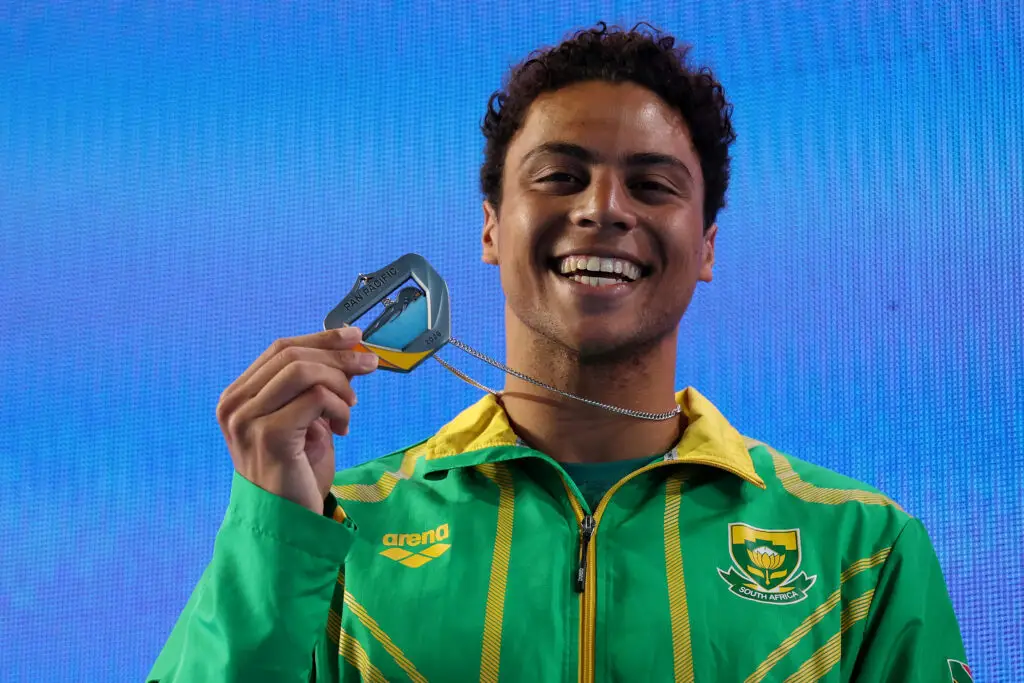
IRVINE, CALIFORNIA - AUGUST 14: Silver medalist Michael Houlie of Team South Africa poses for a photo after the Men's 50m Breaststroke Final on Day 3 of the Pan Pacific Swimming Championships at William Woollett Jr. Aquatics Center on August 14, 2026 in Irvine, California. (Photo by Maddie Meyer/Getty Images)
“Every race gives you feedback, and that feedback helps shape the next step,” he says. “As I always say, every race teaches you something. That’s the mindset I’m taking towards LA2028.”