We sit here today, not just as reporters or media professionals, but as proud South Africans—grateful, humbled, and deeply moved.
Covering the 2025 FISU World University Games in Germany has been nothing short of a dream fulfilled. As the only officially accredited, privately owned South African media house present at the Games, we came self-funded, driven purely by passion and purpose. Our mission was simple: to capture as many moments as possible from our athletes’ journeys and share them with the people back home. And perhaps, to make them feel a little closer to the greatness quietly unfolding on this world stage.
But why does this matter?
Because the World University Games is massive—the second-largest multi-sport event on the planet after the Olympics. Over 8,000 athletes, officials, and volunteers from more than 120 countries gathered to compete, connect, and chase glory. Yet, despite its scale, many in South Africa still haven’t heard of it. We want to change that.
This year’s Games were hosted across the Rhine-Ruhr region of Germany—Bochum, Duisburg, Essen, Mülheim, and Hagen—with swimming and diving held separately in Berlin, more than 400km away. South Africa proudly competed in 8 of the 18 sporting codes, represented by the top university athletes, some who have already made Olympic history. Names like Bayanda Walaza (Athletics), Harry Saner (Fencing), Pieter Coetzé (Swimming), and Lythe Pillay (Athletics) serve as proof that student-athletes are not just the future— they’re already standing tall among the world’s best..
At Sport South Africa, we are still a small and growing team. But covering this monumental event felt like a turning point. A signal that we’re on the right track. That we can give our athletes the platform their efforts have earned. That we should be telling these stories—every single one of them.
So let’s begin with Day 0: A night of lights, pride, and emotion—the Opening Ceremony.
It was a spectacular celebration, full of colour, culture, and anticipation. Although our swimming and diving teams couldn’t attend the main event due to their competitions in Berlin, they shared their own satellite ceremony, linked via live stream. And while the distance was real, the unity was not lost.
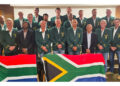
South African Olympian Harry Saner was given the honour of carrying the national flag into the main arena—an electrifying moment. As he walked into the sold-out 25,000-seat stadium, surrounded by teammates, the pride on his face was undeniable. It was mirrored in the faces of every athlete in green and gold. When the announcer called, “South Africa!” and the cheers erupted, we felt it. Deeply. Because in that moment, they weren’t just athletes—they were ambassadors. For their sport. For their universities. For all of us.
And as the rooftop fireworks lit up the night sky and a futuristic flame met the traditional torch, the message was clear: Let the Games begin.
No one slept easily that night. The magnitude of what was to come kept adrenaline high and hearts full.