As the clock ticks down to the Glasgow 2026 Commonwealth Games, we are looking back at the foundation of South Africa’s modern sporting legacy. In the first of our definitive retrospective series, we return to the year everything changed: 1994.
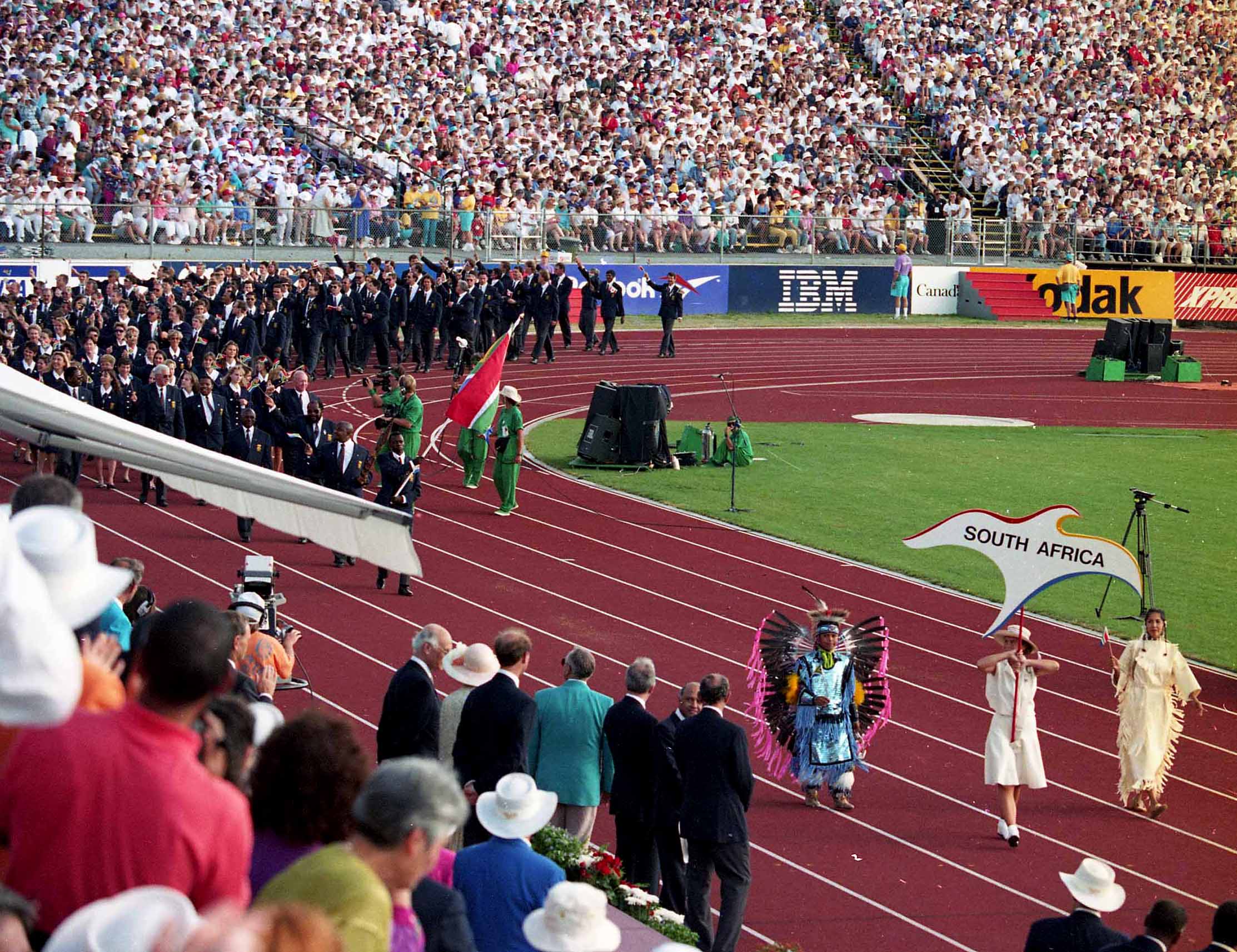
Thirty-six years. That is how long South Africa spent in the sporting wilderness, isolated from the Commonwealth Games due to apartheid. When the nation finally marched into the Centennial Stadium in Victoria, British Columbia, in August 1994, it was more than just a return to international competition—it was the global debut of the Rainbow Nation.
The pressure was immense, yet the South African athletes delivered a masterclass in resilience, bringing home 11 medals (2 Gold, 4 Silver, and 5 Bronze) across four different sporting codes.
While the names of these legends are etched in the history books, the finer details of their triumphs are often forgotten. Here is a deep dive into how Team South Africa re-announced itself to the world, packed with the incredible insights that defined the 1994 Games.
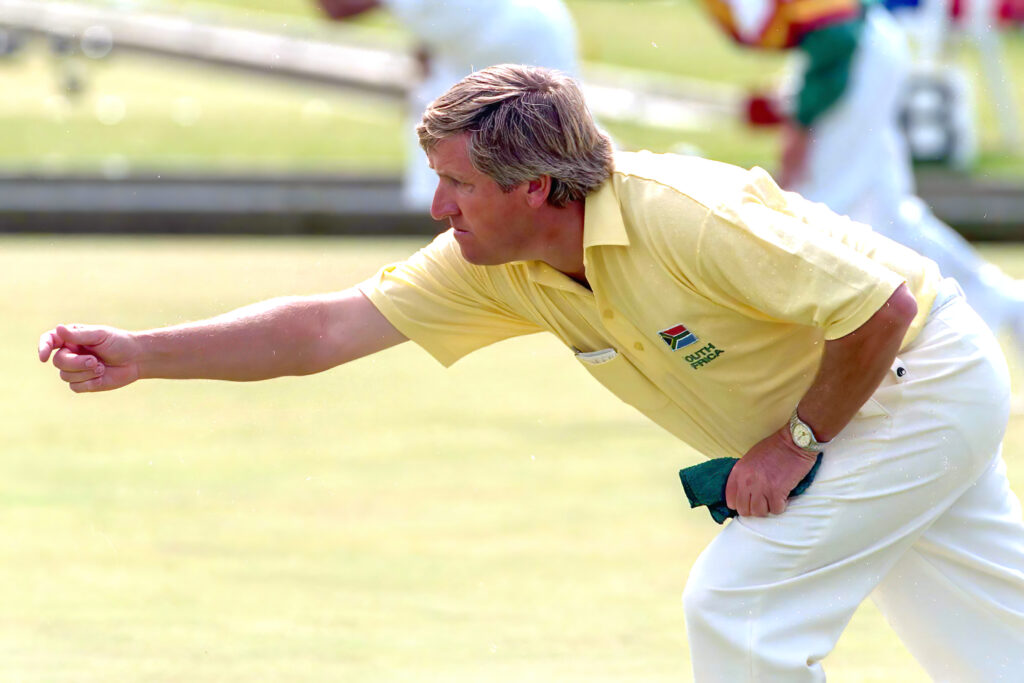
VICTORIA, CANADA - AUGUST 1994: South Africa mens Law bowling during the Opening Ceremony South Africa's re-entry into the Commonwealth Games on August 1994 in Victoria, Canada . (Photo by Wessel Oosthuizen/Gallo Images)
The Golden Greens: Total Dominance in Lawn Bowls
When you think of the sports that paved the way for post-readmission gold, Lawn Bowls stands at the very top of the podium. South Africa didn’t just participate on the greens of Victoria; they dominated, securing both of the nation’s gold medals at the Games.
Men’s Fours (Gold): In a fiercely contested battle against our traditional sporting rivals, Australia, the quartet of Alan Lofthouse, Donald Piketh, Neil Burkett, and Robert Rayfield held their nerve to win the final 21-18.
Women’s Fours (Gold): The women’s team proved equally unstoppable. Anna Pretorius, Colleen Grondein, Hester Bekker, and Lorna Trigwell secured a decisive 24-17 victory over Papua New Guinea to claim the top spot.
Women’s Pairs (Silver): The dominance nearly yielded a third gold, but Lyn Dwyer and Jo Peacock ultimately fell 31-18 to a strong Scottish duo in the final, walking away with a proudly earned silver.
South Africa’s lawn bowls squad was arguably the most lethal unit of the 1994 touring team, taking home three medals and proving that the nation’s tactical precision had not faded during their decades away from the Games.
Track and Field: History Makers and Heartbreak
The athletics team provided some of the most emotional and historic moments of the entire Victoria Games, bagging five medals against world-class fields.
The Breakthrough of Hezekiél Sepeng
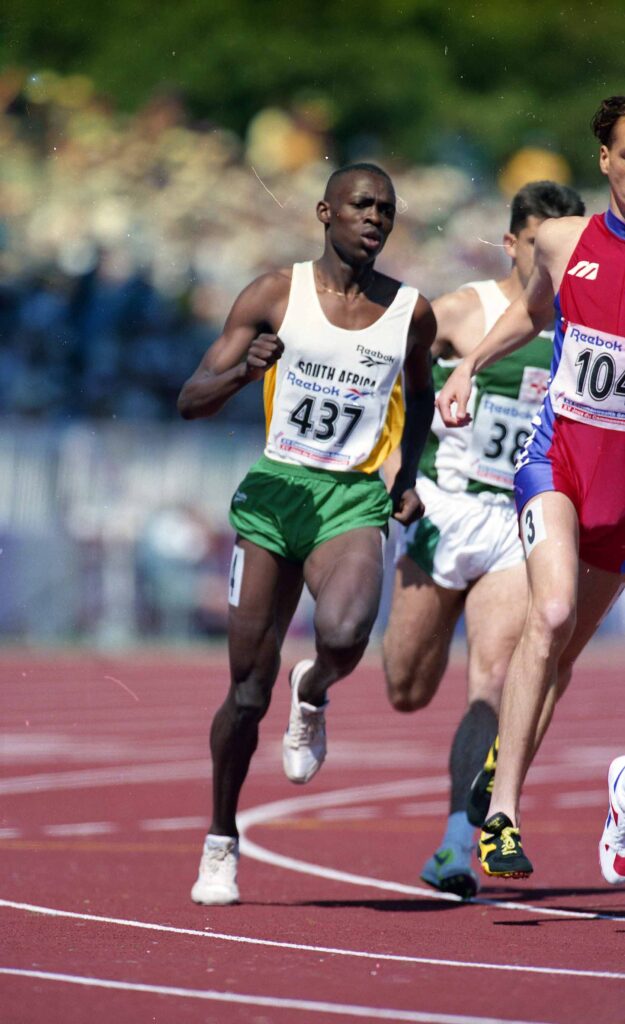
In the men’s 800m, Hezekiél Sepeng carved his name into the history books forever. Clocking a blistering 1:45.76, Sepeng claimed silver just behind Kenya’s Patrick Konchellah.
The Historic Impact: With this phenomenal run, Sepeng became the very first Black athlete to win a Commonwealth Games medal for South Africa, tearing down barriers and inspiring a generation of future track stars.
VICTORIA, CANADA - AUGUST 1994: South Africa's re-entry into the Commonwealth Games on August 1994 in Victoria, Canada . (Photo by Wessel Oosthuizen/Gallo Images)
The High Jump Countback Heartbreak
Perhaps the most overlooked, yet fascinating, story of the ’94 Games belongs to high jumper Charmaine Weavers. She cleared a massive height of 1.94m—a height that not only set a new Commonwealth Games record at the time but exactly matched the height cleared by the eventual gold medalist, Australia’s Nicole Boegman.
The Insight: Weavers did not lose because she couldn’t jump as high as the champion; she had to settle for silver purely on countback due to having more failed jumps at lower heights during the progression. It was as close to a shared gold as the sport allows.
Distance and Discus Power
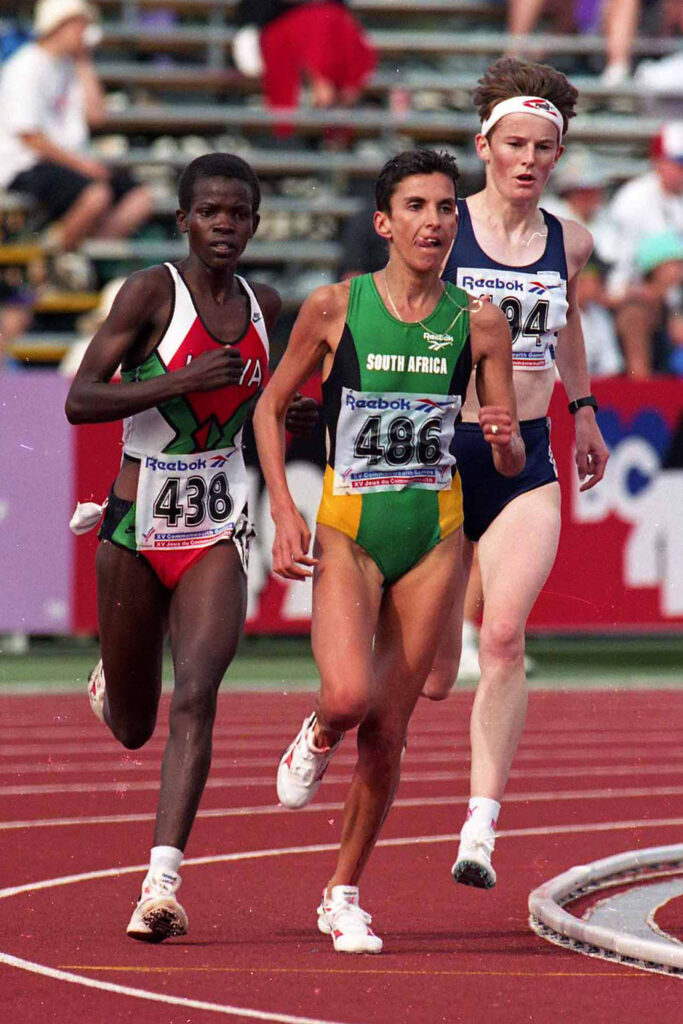
The women’s squad continued to pile on the hardware. Long-distance icon Elana Meyer dug deep to claim silver in the 10,000m (32:06.02) behind Scotland’s Yvonne Murray. In the 1500m, Gwen Griffiths secured a hard-fought bronze (4:10.16) in a star-studded race won by England’s legendary Kelly Holmes. Meanwhile, in the field, Lizette Etsebeth launched the discus 55.74m to take bronze, splitting the southern hemisphere dominance of Australia and New Zealand.
VICTORIA, CANADA - AUGUST 1994: Elana Meyer during South Africa's re-entry into the Commonwealth Games.
(Photo by Wessel Oosthuizen/Gallo Images)
The Grueling Road and The Unearthing of a Pool Legend
Outside the stadium, South African grit was on full display on the tarmac and in the water.
Pedal to the Medal
The Men’s Road Race is notoriously unforgiving, a 180km test of pure endurance. Against a dominant field, South Africa’s Willie Engelbrecht held his own, securing a brilliant bronze medal just behind a powerful New Zealand duo (Mark Rendell and Brian Fowler) who took the top two spots.
Making Waves in the Pool
The swimming team delivered two crucial bronze medals, but one of them was a glaring sign of things to come.
The Sprint: Peter Williams showcased his explosive speed in the Men’s 50m Freestyle, touching the wall at 23.16 to take bronze behind England’s Mark Foster and Australia’s Darren Lange.
The Unknown Prodigy: In the Women’s 100m Breaststroke, a young, relatively unknown South African swimmer clocked a 1:09.86 to take bronze behind the Australian pair of Samantha Riley and Rebecca Brown. Her name? Penny Heyns. The Insight: Two years before she would go on to shock the world and become a double Olympic Champion in Atlanta, the 1994 Commonwealth Games served as the international launchpad for arguably the greatest breaststroke swimmer in history.